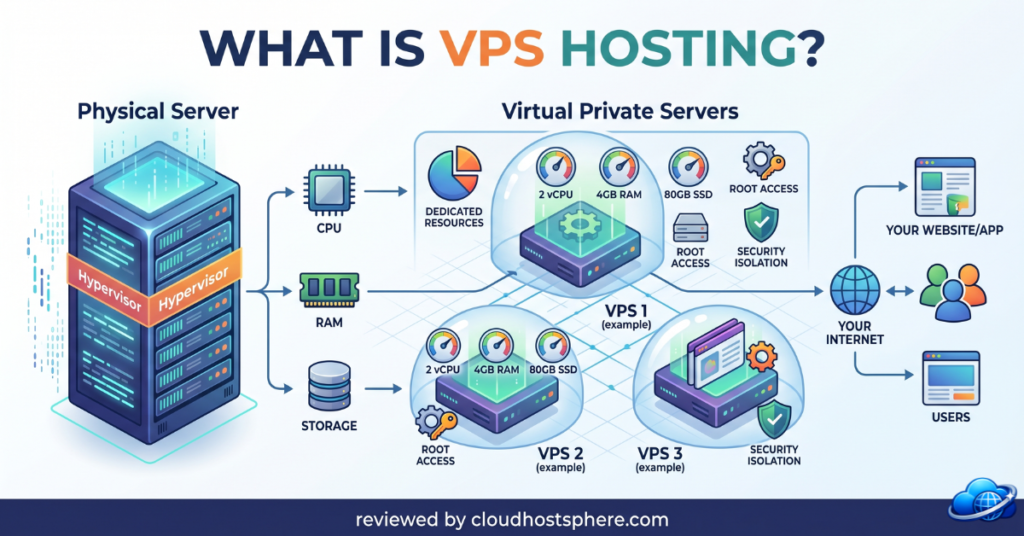
“VPS hosting” is one of those terms that gets thrown around constantly, but rarely explained in plain English. If you’ve ever wondered what a VPS actually is, whether you need one, and how it’s different from shared hosting or the cloud — this guide is for you. No jargon, no assumptions. By the end, you’ll understand exactly what VPS hosting is and whether it’s the right move for your website. Let’s start from the beginning.
⚡ In One Sentence
A VPS (Virtual Private Server) gives your website its own dedicated slice of a server — guaranteed power and resources that nobody else can touch — at a fraction of the cost of renting a whole physical server.
What Does VPS Actually Stand For?
VPS stands for Virtual Private Server. Let’s break those three words down, because each one tells you something important:
- Virtual — it’s created using software that splits one powerful physical server into several separate virtual ones
- Private — your slice is yours alone; your resources (CPU, RAM) are reserved for you and isolated from everyone else
- Server — it’s a server that hosts your website, app, or files
So a VPS is a private, guaranteed portion of a server that behaves like your own dedicated machine — even though it physically shares hardware with other VPS users.
The Apartment Building Analogy
The easiest way to understand hosting types is to think about places to live:
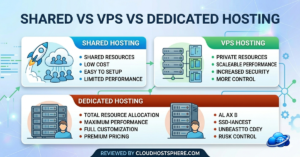
- Shared hosting = a room in a shared house. Cheap, but you share the kitchen, bathroom, and utilities with everyone. If a housemate hogs the hot water, you feel it.
- VPS hosting = your own apartment in a building. You have your own private space, your own guaranteed utilities, and your own front door. Neighbours exist, but they can’t use your space or your resources.
- Dedicated server = owning the entire building. Total control and space, but expensive and all the maintenance is yours.
VPS hosting is the comfortable middle ground — your own private, guaranteed space, without the cost of owning the whole building.
How VPS Is Different from Shared Hosting
| Feature | Shared Hosting | VPS Hosting |
|---|---|---|
| Resources (CPU/RAM) | Shared with everyone | Guaranteed & private to you |
| Performance | Variable (noisy neighbours) | Consistent & isolated |
| Control | Limited | Full root access (if you want it) |
| Scalability | Limited | Scale resources on demand |
| Price | Cheapest ($2–$10/mo) | Mid-range ($5–$50/mo) |
| Best for | Small/new sites | Growing sites & apps |
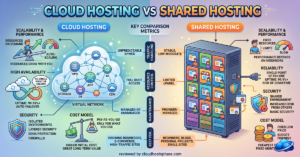
The single biggest difference is the “noisy neighbour” problem. On shared hosting, if another site on your server suddenly gets a traffic spike or runs heavy scripts, your site can slow right down. On a VPS, your resources are walled off — what your neighbours do can’t affect you. (For a deeper dive, read our cloud vs shared hosting guide.)
Signs You’ve Outgrown Shared Hosting (and Need a VPS)
- 📈 Your traffic is growing and your site feels slower than it used to
- ⏳ Pages load sluggishly, especially at busy times
- ⚠️ Your host emails you about “resource limits” or throttling
- 🛒 You’re running a store where speed and uptime affect sales
- 🔧 You need custom server settings your shared host won’t allow
- 💥 Your site crashes during traffic spikes
If two or more of these sound familiar, it’s probably time to step up to a VPS.
Managed vs Unmanaged VPS: The Crucial Choice
This is the most important decision when choosing a VPS, so let’s make it crystal clear:
✅ Managed VPS
The host handles server setup, security, updates, and maintenance. You focus on your website. Best for most people and businesses.
🔧 Unmanaged VPS
You get a raw server and full control, but you’re responsible for everything — security, updates, fixes. Cheaper, but for developers & technical users.
Simple rule of thumb: if you’re not confident managing a Linux server yourself, choose managed. The small extra cost is absolutely worth it for the peace of mind.
What About “Cloud VPS”?
You’ll often see the term cloud VPS. This is simply a VPS that runs on cloud infrastructure — a network of connected servers — rather than a single physical machine. The big advantage is reliability and scaling: if one server has a problem, your VPS shifts to another, and you can add resources instantly. Most modern, quality VPS hosting is cloud-based, which is a good thing. Providers like Vultr, Kamatera, and ScalaHosting all offer cloud VPS.
How Much Does VPS Hosting Cost?
VPS pricing is more affordable than most people expect:
- Unmanaged cloud VPS — from around $5/month (e.g. Vultr, DigitalOcean)
- Value VPS — from around $6/month with price-lock options (e.g. InterServer)
- Managed cloud VPS — from around $11–$15/month (e.g. Cloudways, ScalaHosting)
- Enterprise/custom cloud — pay for exactly what you configure (e.g. Kamatera)
For the jump in performance, reliability, and control you get, even managed VPS hosting is remarkably good value.
How to Choose the Right VPS
- Decide managed or unmanaged first — this narrows everything down
- Look for NVMe/SSD storage — for fast performance
- Check the data centre locations — pick one close to your audience
- Confirm easy scaling — so you can grow without migrating
- Check backups & security are included — especially on managed plans
- Read the support details — 24/7 help matters when you’re running a server
Our Recommended VPS Hosts
🥇 Best Managed VPS
ScalaHosting — affordable managed cloud VPS with free SPanel & SShield security.
Read VPS Guide →The Bottom Line
VPS hosting is the natural next step once your website outgrows shared hosting. It gives you guaranteed resources, consistent performance, room to scale, and far more control — all without the cost of a dedicated server. If your site is growing, slowing down, or hitting resource limits, a VPS is almost certainly the upgrade you need. Decide whether you want it managed (easiest, recommended for most) or unmanaged (cheaper, for the technical), pick a quality provider, and enjoy a faster, more reliable website. For our full picks, see our best VPS hosting roundup.
🚀 Ready for a VPS?
For the best balance of power and simplicity, ScalaHosting’s managed cloud VPS is our top pick. Prefer raw developer power? Vultr is brilliant value.
See Our Top VPS Picks →Last updated: June 5, 2026.